
Article Summary
- Most Atlanta restaurant operators manage daily kitchen maintenance reasonably well. Equipment gets wiped down, floors get mopped, refrigeration gets checked, and invoices get paid. But one maintenance task that affects fire safety, regulatory compliance, staff health, and kitchen performance more than almost any other gets overlooked more consistently than any item on the list.
- Hood cleaning in Atlanta is the maintenance task that generates the most inspection violations, the most fire-related incidents, and the most costly emergency corrections across commercial kitchens in the Atlanta metro area, precisely because it’s the one that falls through the cracks most reliably.
- The reasons hood cleaning gets overlooked are predictable and understandable. The exhaust system accumulates grease in places nobody looks during normal service. The consequences of neglect build gradually rather than arriving with a clear warning. And the cleaning itself happens outside of normal service hours, making it easy to defer when the schedule gets complicated.
- Understanding why this specific maintenance task gets overlooked, what the consequences look like when it does, and how to build it into restaurant operations in a way that makes it impossible to miss is the practical purpose of this article.
- Hood cleaning in Atlanta is not complicated to manage correctly. It requires knowing the right cleaning frequency for your cooking type, choosing a professional company that covers the complete system, maintaining proper documentation, and building the service into your operations calendar as a fixed commitment rather than a reactive response.
- This article is for Atlanta restaurant operators who want to stop treating their most consequential maintenance task as an afterthought and start managing it with the consistency it deserves.
- Because neglecting exhaust maintenance leads to accumulated grease, severe inspection fines, and reduced indoor air quality, understanding why kitchen ventilation matters for Atlanta restaurant staff and customers helps operators establish consistent cleaning schedules and safeguard their working environment.
The Maintenance Task That Atlanta Restaurants Consistently Miss
Walk through any busy commercial kitchen in Atlanta during service and the visible maintenance is almost always getting done. The line is clean. Equipment surfaces are wiped between uses. The floor mats are in place. The walk-in is organized. The health inspection score is posted prominently.
These are the maintenance tasks that are visible, that get checked daily, that have clear feedback loops when they’re neglected. A dirty line gets noticed immediately. A spill on the floor is obvious. Equipment that isn’t wiped down is apparent at a glance. The consequences of neglecting these tasks are immediate and visible, which is why they get done.
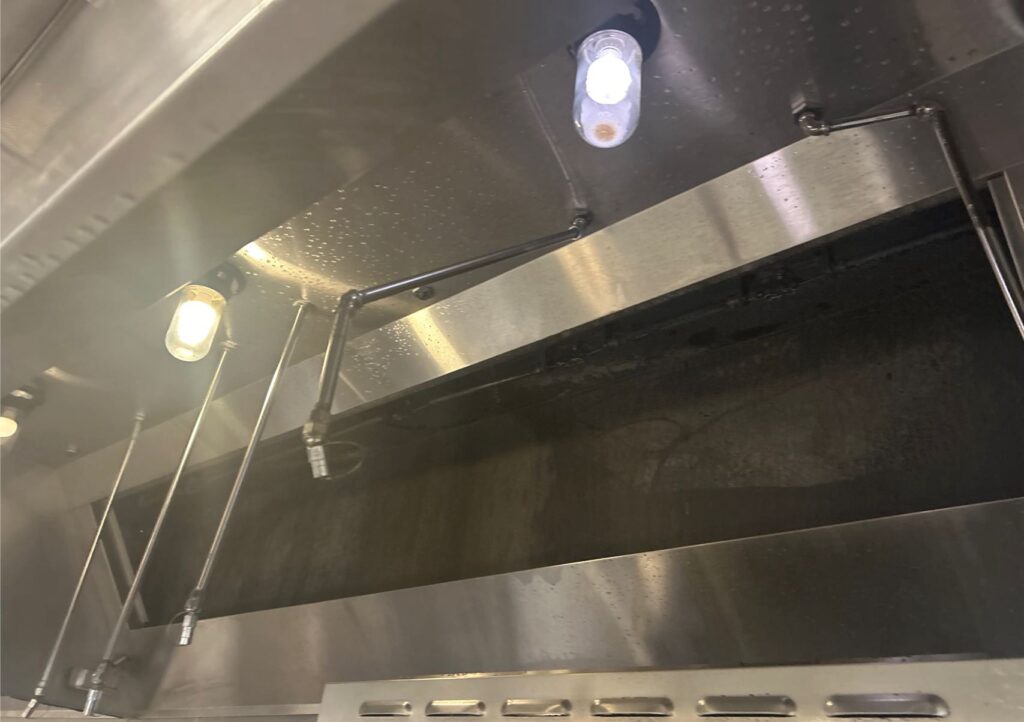
Hood cleaning in Atlanta is the inverse of all of these. The exhaust system accumulates grease in places nobody looks during normal service. The duct interior is behind access panels in ceiling spaces. The exhaust fan is on the rooftop. The plenum chamber is behind the baffle filters. The consequences of neglecting these components build gradually, invisibly, over weeks and months, until they reach a threshold where they produce a result that’s impossible to ignore: a failed fire inspection, a forced closure, a kitchen fire, or an exhaust fan failure during a busy service.
That combination of invisibility and gradual consequence is exactly what makes hood cleaning in Atlanta the most consistently overlooked maintenance task in the city’s commercial kitchens. And it’s why the cost of neglecting it is so disproportionately high relative to the cost of managing it properly.
Why Hood Cleaning Gets Overlooked: The Root Causes
Before getting into the consequences of neglect and the solution, it’s worth being specific about why this particular maintenance task falls through the cracks so reliably. The reasons are predictable, and identifying them makes it possible to design a maintenance approach that addresses each one.
The System Is Invisible During Normal Operations
The most fundamental reason hood cleaning gets overlooked is that the exhaust system components that accumulate the most consequential grease are physically invisible during normal kitchen operations. Nobody is walking past the duct interior during a dinner service. The exhaust fan on the rooftop is never seen by anyone in the kitchen. The plenum chamber behind the baffle filters is not a surface that gets checked between services.
The parts of the exhaust system that kitchen staff do see regularly, including the underside of the hood canopy and the face of the baffle filters, are the parts that accumulate grease more visibly. These are also the parts that kitchen staff sometimes clean between professional service visits, which creates a false impression that the system is being maintained when in fact the cleaning is reaching only a fraction of the components that matter.
A kitchen manager who looks at the hood and sees a surface that’s been recently wiped down may conclude that the exhaust system is in reasonable condition. The duct interior behind the access panels in the ceiling space may contain months of hardened grease accumulation that the surface wipe-down has done nothing to address.
The Consequences Are Gradual and Non-Linear
Grease accumulation in an exhaust system doesn’t produce a clear warning signal at the point where it crosses from acceptable to problematic. It builds continuously from the first cooking service after a cleaning, accumulating layer by layer in a process that produces no single moment where the problem becomes obvious.
The consequences of this accumulation, including increased fire risk, reduced airflow performance, progressive fan imbalance, and deepening compliance exposure, develop in proportion to the accumulation rather than as sudden events. A kitchen that hasn’t been cleaned in four months is in a worse position than one that hasn’t been cleaned in two months, but the difference may not be immediately apparent from inside the kitchen during a normal service.
This gradual, non-linear consequence pattern means that operators often have no clear signal that they’ve crossed into problematic territory until an inspection or an emergency makes it undeniable. By the time the signal arrives, the accumulation has typically reached a level where correction is more complex, more expensive, and more disruptive than it would have been with consistent preventive maintenance.
The Cleaning Happens Outside Normal Service Hours
Professional hood cleaning in Atlanta is almost always scheduled outside of service hours, after closing or on a day when the kitchen is closed. This means the cleaning occupies a time slot that competes with every other demand on the restaurant operator’s after-hours attention, which are often substantial.
When the cleaning is scheduled for 11 PM, and the last service ran long, when the kitchen team is short-staffed, and the manager has to cover the line, when a vendor issue needs to be resolved before the next day’s delivery, the hood cleaning that was supposed to happen tonight becomes the hood cleaning that gets rescheduled for next week. And then next week has its own complications. And the interval between cleanings extends past the required frequency without anyone making an explicit decision to defer it.
This scheduling vulnerability is one of the most common paths by which Atlanta restaurants end up with overdue hood cleaning. Not deliberate neglect, but accumulated deferrals that each seemed reasonable in the moment.
The Service Is Out of Sight During Execution
Even when hood cleaning does happen, the fact that most of the work is done in areas the operator doesn’t see during normal service makes it difficult to evaluate whether the service covered what it should have. A cleaning crew that spends two hours in the kitchen and leaves a service sticker on the hood has produced a result that looks legitimate from the kitchen floor. Whether they accessed the duct interior through the access panels and cleaned the exhaust fan on the rooftop is invisible to an operator who doesn’t specifically know to ask and verify.
This lack of visibility during execution is part of why incomplete hood cleaning services persist in the Atlanta market. The operator can’t easily distinguish between a complete-system cleaning and a hood-and-filter cleaning based on what they observe from the kitchen floor. The difference becomes apparent only when the documentation is reviewed or when an inspector looks through the access panels and finds the duct interior uncleaned.
The Regulatory Requirement Is Abstract Until Enforcement
NFPA 96 and the Atlanta Fire Rescue Department’s enforcement of commercial kitchen fire codes are abstract concepts until a fire inspector walks into the kitchen and makes them concrete. An operator who has been managing their exhaust system haphazardly for two years without an inspection violation may have developed an implicit belief that the risk of consequences is lower than the regulatory framework suggests.
This belief tends to be disrupted abruptly. An inspection that wasn’t anticipated. A complaint that triggered an unscheduled visit. A permit activity that brought an inspector through the kitchen. Suddenly the abstract compliance obligation becomes a concrete violation notice with a specific correction deadline.
By that point, the maintenance task that was being overlooked has created a compliance problem that costs more to correct than consistent maintenance would have cost to maintain.
What the Consequences Actually Look Like
Understanding the consequences of overlooked hood cleaning in Atlanta helps calibrate the seriousness of the oversight. These aren’t hypothetical risks. They’re the actual outcomes that Atlanta commercial kitchen operators experience when exhaust system maintenance is neglected.
The Fire Inspection Failure
The most common immediate consequence of overlooked hood cleaning is a fire inspection failure that includes exhaust system violations. When an Atlanta Fire Rescue Department inspector or a Fulton County Fire and Emergency Services inspector finds the combination of overdue cleaning, grease accumulation visible in the hood and duct system, and missing or outdated documentation, the result is a violation notice with a correction deadline.
For Atlanta restaurant operators who haven’t been thinking about the exhaust system, this inspection failure often arrives as a genuine surprise. The kitchen looks clean. The equipment is functioning. The health inspection score is good. And then the fire inspector is citing NFPA 96 violations that were building quietly in the duct system and on the rooftop exhaust fan while the restaurant was focused on everything else.
The correction process, including scheduling an emergency professional cleaning, addressing any structural issues that the inspection identified, and arranging a re-inspection, costs more than consistent preventive maintenance would have and disrupts operations at a time when disruption is never convenient.
The Forced Closure
When inspection violations are serious enough, the Atlanta Fire Rescue Department has the authority to direct a kitchen to cease cooking operations until the violations are corrected. This is the fire inspection consequence that Atlanta restaurant operators fear most, and it’s the one that turns an abstract compliance obligation into an immediate financial emergency.
A forced closure during a high-revenue period- a weekend night, a holiday, a convention week- is a direct revenue loss without a corresponding reduction in fixed costs. Staff who show up for a shift that the kitchen can’t run still represent a payroll obligation. Reservations that get canceled represent revenue that may not be recoverable. Customers who encountered a closed restaurant may not return.
The operator who experiences a forced closure and traces it back to a hood cleaning schedule that was allowed to slip is experiencing the full financial consequence of the overlooked maintenance task in a single event.
The Equipment Failure
When exhaust fan maintenance is overlooked as part of the broader hood cleaning neglect pattern, the mechanical consequences develop on a timeline that leads to unplanned equipment failure. Grease accumulation on the exhaust fan impeller creates imbalance. Imbalance creates vibration. Vibration accelerates bearing wear. Bearing wear progresses until the bearing fails.
This failure can happen during any service. It doesn’t wait for a slow Tuesday. When the exhaust fan fails during a busy Saturday dinner service in a high-volume Atlanta restaurant, the immediate question is whether the kitchen can continue to operate without exhaust ventilation. In most cases, it can’t operate safely, which means the service stops.
The emergency repair or replacement of a failed exhaust fan comes at premium rates. Parts procurement may require expedited shipping if the specific fan model isn’t immediately available from local suppliers. Labor for emergency overnight repair adds to the cost. The revenue lost during the repair window adds more. And the root cause, grease accumulation on the impeller that could have been prevented through regular professional cleaning, was building for months or years before the failure.
The Grease Fire
The most severe consequence of overlooked hood cleaning is a grease fire that originates in the exhaust system. Grease accumulation in the duct system is the fuel load that duct fires require. When that accumulation reaches sufficient depth and is exposed to the heat generated by cooking operations, or to a flare-up that sends flame into the duct above the cooking surface, the duct fire propagates upward through the system.
Duct fires in commercial kitchens are among the most serious fire events that Atlanta’s fire suppression and emergency response infrastructure deals with. The fire travels through the duct rather than being contained at the cooking surface, generating intense heat and potentially spreading to the surrounding building structure. The recovery timeline from a serious duct fire event can range from weeks to months, with financial consequences that include equipment replacement, building repair, insurance claims processes, and in some cases permanent closure.
This is the consequence that NFPA 96’s cleaning requirements are specifically designed to prevent. Every cleaning at the correct frequency removes the fuel load before it reaches the threshold at which ignition becomes a serious risk. The kitchen that’s maintained its cleaning schedule consistently is a kitchen that has never accumulated enough grease to sustain a duct fire.
The Real Cost Comparison: Neglect vs. Maintenance
The financial case for consistent hood cleaning in Atlanta is compelling when the full cost picture is compared between the neglect scenario and the preventive maintenance scenario.
| Cost Category | Preventive Maintenance | Neglect Scenario |
| Professional cleaning (annual) | Predictable scheduled service cost | Emergency cleaning at premium rates |
| Equipment | Normal service life for exhaust fan | Premature bearing failure and replacement |
| Inspection | No violation fees; passing inspection | Re-inspection fees; possible compliance costs |
| Revenue | No service disruption | Revenue loss during forced closure or fire event |
| Rooftop | Manageable accumulation cleaned at each service | Membrane damage requiring roofing repair |
| Insurance | Clean compliance record supports coverage | Maintenance gaps complicate claims |
| Staff | Stable working environment supports retention | Poor conditions contribute to turnover |
| Reputation | No customer-facing compliance incidents | Forced closure visible to customers and community |
The preventive maintenance column has predictable, budgetable costs. The neglect column has unpredictable costs that can arrive simultaneously, compounding each other in ways that make the financial impact of a single neglect-driven event substantially larger than any individual cost element suggests.
Why Hood Cleaning Specifically Is the Most Overlooked Task
Hood cleaning isn’t the only maintenance task that Atlanta restaurants overlook. Exhaust fan mechanical service, fire suppression system inspections, and grease trap cleaning are all maintenance obligations that get deferred more often than they should. But hood cleaning specifically occupies the position of most overlooked for several converging reasons.
It’s the maintenance task that carries the most serious fire safety consequence when neglected. It’s the one that NFPA 96 addresses most specifically and that Atlanta fire inspectors evaluate most carefully. It’s the one where the gap between what operators believe is happening and what’s actually happening- that cleaning service that never went to the rooftop, that quarterly schedule applied to a monthly kitchen- is widest and most consequential.
And it’s the one where the solution is most straightforward. Professional hood cleaning in Atlanta, performed by a company that covers the complete system at the correct NFPA 96-required frequency with proper documentation, addresses all of the fire safety, compliance, equipment, and performance dimensions of the overlooked maintenance problem in a single, recurring service.
Other overlooked maintenance tasks have their own solutions that require different contractors or different service relationships. Hood cleaning is unique in that the same professional service that addresses fire safety also addresses equipment longevity, ventilation performance, staff working conditions, and regulatory compliance simultaneously. It’s the highest-leverage maintenance investment available to an Atlanta restaurant operator, which is one of the reasons its neglect is so consequential.
The Most Common Patterns of Hood Cleaning Neglect in Atlanta
Overlooked hood cleaning in Atlanta commercial kitchens tends to follow recognizable patterns. Understanding these patterns helps operators identify whether their own maintenance approach has any of the vulnerabilities that lead to the neglect scenario.
The Deferred Cleaning That Never Gets Rescheduled
The most common neglect pattern begins with a single scheduling deferral that was genuinely reasonable. A cleaning crew cancellation. A kitchen emergency that made the original service window impossible. A staffing situation that left nobody available to stay for the service.
The deferral gets noted but not immediately rescheduled. Days pass. Other operational priorities fill the space where the rescheduling conversation should have happened. The cleaning that was supposed to happen last Tuesday is now a month overdue, and it still hasn’t been rescheduled because nothing visible has gone wrong yet to make it urgent.
This pattern repeats once or twice more, and a quarterly kitchen has gone seven or eight months without a cleaning. A monthly kitchen has gone three or four months. Both are now operating significantly outside their NFPA 96-required frequency, with accumulation in the duct system that reflects the missed services.
The Incomplete Cleaning That Creates False Confidence
A second common pattern involves a restaurant that is scheduling hood cleaning on an appropriate frequency but receiving incomplete service from a low-price cleaning company that doesn’t cover the duct interior and the exhaust fan. The operator sees regular service stickers going on the hood, pays regular invoices, and believes the exhaust system is being maintained.
The duct interior and exhaust fan are accumulating grease with every service, unaddressed by the cleaning company that comes monthly or quarterly. When an inspector eventually looks through the access panels, the duct interior reveals the full accumulation history because nothing has been cleaning it.
This pattern is particularly frustrating for operators who discover it, because they were doing what they believed to be the right thing and paying for service they weren’t receiving. The solution is switching to a cleaning company that explicitly covers the complete system and provides before-and-after photographs that demonstrate the duct interior and exhaust fan cleaning actually happened.
The Frequency Mismatch
A third pattern involves a kitchen that’s receiving genuine complete-system cleaning on a regular schedule, but on a schedule that doesn’t match the NFPA 96 requirement for the kitchen’s cooking type. The most common version is a charbroiler kitchen on a quarterly schedule that should be monthly.
The operator knows they’re getting regular cleaning. The service sticker is current. The service reports are on file. But the cleaning frequency has been set at a level that’s inadequate for the grease accumulation rate in the specific kitchen, and the system is spending two of every three months in a state of accumulation above the safe threshold.
This pattern often originates in the initial setup of the cleaning relationship, where the cleaning frequency was determined without a careful assessment of the cooking equipment type and volume. It may have been the frequency that the previous operator used, or the frequency that the cleaning company suggested without properly evaluating the kitchen’s specific requirements.
The Ownership Transition Gap
A fourth pattern is specific to restaurant ownership transitions and new openings. When a restaurant changes hands, the maintenance history often doesn’t transfer clearly. The new operator may not know what cleaning schedule the previous operator used, what company performed the cleaning, where the service records are, or when the last cleaning occurred.
Without a clear starting point, the new operator may defer setting up a cleaning relationship until they feel more settled in the operation. Meanwhile, the exhaust system continues accumulating grease on whatever timeline the previous operator’s maintenance approach established, which may already have been overdue at the time of transition.
New restaurant openings face a related version of this gap. An operator focused on opening logistics, menu development, staffing, and vendor relationships may treat the hood cleaning setup as something to handle once the restaurant is operating. The first few weeks of cooking service happen without a cleaning relationship in place, and the system begins accumulating grease from the first day of operations without a maintenance plan to address it.
How to Stop Overlooking Hood Cleaning: A Practical Framework
The solution to the overlooked hood cleaning problem isn’t complicated. It’s a combination of four elements that, taken together, make it effectively impossible for the maintenance to slip through the cracks.
Element One: Know the Correct Frequency
The foundation is knowing the specific NFPA 96-required cleaning frequency for the kitchen’s actual cooking type and volume. This isn’t a generic determination. It requires an honest assessment of what equipment is in use, what cooking methods are applied, and what volume of cooking happens during a typical service period.
The core frequency categories under NFPA 96:
- Monthly for solid-fuel cooking, high-volume charbroiling, wok cooking, and 24-hour operations
- Quarterly for moderate-volume cooking with fryers, griddles, and standard commercial ranges
- Every six months for low-volume cooking, limited hours, and primarily oven-based menus
- Annually for very low-volume operations, seasonal kitchens, and intermittent-use facilities
If any equipment addition or menu change has occurred since the last frequency assessment, the assessment should be revisited. A restaurant that added a charbroiler since its cleaning schedule was established may have moved from quarterly to monthly without anyone updating the schedule.
Element Two: Choose the Right Cleaning Company
The cleaning company is the most consequential vendor relationship in commercial kitchen exhaust system maintenance. A company that covers the complete system at every visit, provides comprehensive documentation, and communicates proactively about what each service reveals is a fundamentally different partner than one that cleans the visible hood surfaces, applies a sticker, and leaves without going to the rooftop.
The questions that distinguish complete-system providers from incomplete ones:
- Does your service include the duct interior, accessed through the access panels?
- Do your technicians go to the roof to clean the exhaust fan at every service?
- Do you provide before-and-after photographs of the duct interior, the exhaust fan, and the rooftop at every service?
- How long does a complete service take for a kitchen of this size?
- What does your service report specifically include?
A company that answers these questions directly and specifically, with concrete descriptions of what the duct cleaning and exhaust fan cleaning involve, is a company performing the complete service. Vague answers or redirection toward describing the hood cleaning in more detail without answering the duct and rooftop questions directly are signals of a limited-scope service.
Element Three: Build the Schedule Into Operations
The scheduling vulnerability, the pattern where individual deferrals accumulate into significant overages, is addressed by treating the cleaning calendar as a fixed operational commitment rather than a flexible scheduling option.
Specific practices that protect the cleaning schedule:
- Schedule all service visits for the coming year in a single planning session at the beginning of each year
- Add service dates to the operations calendar with the same permanence as lease payment dates and equipment service contracts
- Set a calendar reminder two weeks before each scheduled service to confirm the appointment and ensure access arrangements are in place
- Assign a specific person to own the maintenance calendar, with the authority and responsibility to ensure each service happens at the scheduled interval
- Establish a protocol for rescheduling any deferred service immediately to a specific date within the current week rather than leaving it open-ended
Element Four: Maintain the Documentation System
Documentation is the compliance component that makes the maintenance program defensible during inspections and protects the restaurant’s insurance position. A documentation system that works requires three things: receiving complete documentation after every service, filing it immediately rather than setting it aside, and organizing it so it’s retrievable quickly when an inspector asks for it.
Practical documentation system elements:
- A dedicated compliance folder, physical or digital, specifically for exhaust system service records
- A filing practice that puts each new service report into the folder on the day it’s received
- A monthly check of the service sticker date against the required cleaning frequency
- Service records retained for at least 12 months and ideally for the duration of the current ownership
Turning the Most Overlooked Task Into the Best-Managed One
The Atlanta restaurant operators who move from treating hood cleaning as an afterthought to treating it as a foundational operational practice consistently find that the transition is less disruptive than they expected and more impactful than they anticipated.
The cleaning schedule is set. The service happens on time. The documentation is organized. The fire inspector walks through and finds nothing to cite. The kitchen runs cooler and cleaner. The exhaust fan keeps running without developing the bearing wear that comes from grease imbalance. The rooftop isn’t developing a grease accumulation problem that will eventually become a structural repair. The insurance coverage remains on firm ground. The staff work in a better environment. The dining room atmosphere is what it should be.
None of this requires exceptional effort. It requires building one maintenance task, the most consequential one in the kitchen, into the operations with the consistency it deserves.
Hood cleaning in Atlanta is the most overlooked maintenance task in Atlanta commercial kitchens, and it’s also the one with the most straightforward path from neglect to consistent management. Know the correct frequency. Choose a company that covers the complete system. Schedule the year in advance. File the documentation when it arrives. That’s the entire program.
Premier Grease has been helping Atlanta restaurant operators build and maintain that program since 2001. Every service we perform covers the complete exhaust system from hood canopy to rooftop fan, cleaned to NFPA 96’s bare-metal standard, with time-stamped before-and-after photographs of every system component and a detailed service report documenting the complete scope of the cleaning. We work with Atlanta operators to establish the correct cleaning frequency for their specific cooking operation, communicate clearly about what each service reveals, and schedule around operating hours so cleaning happens when the kitchen is down.
No contracts required. Licensed, bonded, and insured with $5 million in general liability coverage. We serve restaurants, hotels, hospitals, schools, corporate cafeterias, ghost kitchens, food trucks, and every other type of commercial cooking operation across Atlanta, Fulton County, DeKalb County, Gwinnett County, Cobb County, and surrounding areas within our 100-mile service radius.
Call us 24/7 at 1-800-880-1142 or visit Hood Cleaning Atlanta to schedule a free estimate, get your cleaning frequency assessed against your current cooking operation, and turn your most overlooked maintenance task into your best-managed one.
Premier Grease | Alpharetta, GA | Serving Atlanta and surrounding areas within a 100-mile radius