
Article Summary
- Georgia’s State Minimum Standard Codes establish the legal framework that governs commercial kitchen exhaust systems across the state, including every restaurant, hotel, and food service facility in Atlanta.
- The Georgia Department of Community Affairs (DCA) administers code adoptions — when Georgia updates its fire and mechanical codes, those changes directly affect how your exhaust system must be built, maintained, and inspected.
- NFPA 96, the Standard for Ventilation Control and Fire Protection of Commercial Cooking Operations, is the specific standard that controls hood cleaning, duct construction, and exhaust fan requirements in Georgia commercial kitchens.
- Code updates can change construction requirements for new installations, cleaning frequency expectations, access panel requirements, and the documentation you’re expected to produce during an inspection.
- Atlanta restaurant operators who don’t track code changes risk building violations into renovations and new builds, then facing costly corrections before they can open or pass inspection.
- Understanding how the state code framework connects to your exhaust system makes compliance predictable rather than reactive — and puts you ahead of most of your competitors.
What Are the Georgia State Minimum Standard Codes?
If you’ve ever wondered where Atlanta’s fire inspector gets the authority to issue a violation over your hood system, the answer starts in Atlanta but the rule book comes from the state level. Georgia operates under a set of laws known as the Georgia State Minimum Standard Codes, and these codes establish the legal floor for construction, mechanical systems, fire safety, and building operations across the entire state.
The Georgia Department of Community Affairs — the DCA — is the agency responsible for adopting and updating these codes. When the DCA officially adopts a new version of a code, every jurisdiction in Georgia, including Atlanta and all of Fulton, DeKalb, Gwinnett, and Cobb counties, must either enforce that standard or adopt a stricter local amendment. They cannot go below the state minimum. That’s why “state minimum standard” means exactly what it says — it’s the floor, not the ceiling.
For restaurant and food service operators in Atlanta, two code families matter most when it comes to your exhaust system: the fire code and the mechanical code. Both reference standards that directly control how your kitchen ventilation system must be designed, installed, and maintained. Understanding the relationship between these codes and your exhaust system is genuinely useful — not just during a renovation or new build, but on an ongoing basis, because inspections in Georgia are conducted against the adopted code version, and that version does change.
How Georgia Adopts Model Codes and What That Means in Practice
Georgia doesn’t write its own fire code from scratch. Like most states, it adopts model codes developed by national standards organizations and then applies state-specific amendments where needed. The two primary sources for Georgia’s state minimum standards are:
The International Code Council (ICC), which produces the International Building Code, International Fire Code, International Mechanical Code, and related documents. Georgia has adopted versions of these codes as its state minimums, with amendments that reflect specific Georgia policy decisions.
The National Fire Protection Association (NFPA), which publishes NFPA 1 (the Fire Code), NFPA 96 (the Standard for Ventilation Control and Fire Protection of Commercial Cooking Operations), and hundreds of other safety standards. NFPA 96 is the standard that most directly governs commercial kitchen exhaust systems in Georgia.
Here’s how the adoption process works in practice: a national standards body publishes an updated code or standard. The DCA reviews the new edition, considers Georgia-specific factors, and formally adopts it with or without amendments through the state’s regulatory process. Once adopted, the new version supersedes the previous one, and local jurisdictions — including Atlanta — begin enforcing it.
This matters for restaurant operators because a code update isn’t just a paperwork change. It can mean new physical requirements for duct construction on remodels, revised cleaning frequency expectations, updated access panel spacing requirements, changes to grease containment specifications, or new documentation standards. If you’re planning a kitchen renovation, adding a hood, or opening a new location in Atlanta, building to the current adopted code is the only way to avoid having your new installation flagged during its first inspection.
NFPA 96: The Exhaust System Standard at the Heart of Georgia’s Fire Code
When Georgia fire officials inspect a commercial kitchen exhaust system, NFPA 96 is the document they’re working from. Understanding the scope of NFPA 96 — what it covers, how it’s organized, and how it’s enforced in Atlanta — is one of the most practical things an Atlanta restaurant operator can do.
NFPA 96 covers the full ventilation and fire protection system for commercial cooking operations. That includes:
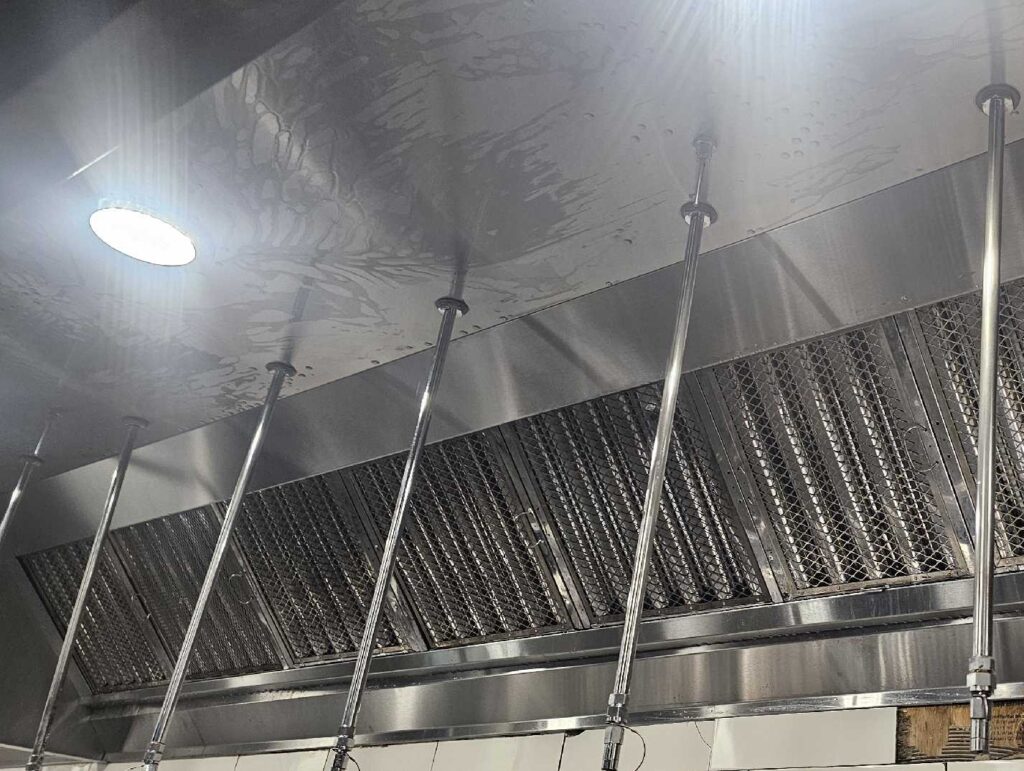
- The hood assembly — the canopy, the plenum, the grease filters, and the grease collection components immediately above the cooking equipment
- The grease duct system — the enclosed pathway that carries cooking exhaust from the hood to the outside, including the duct walls, joints, hangers, and access panels
- The exhaust fan — the rooftop or wall-mounted mechanical unit that drives airflow through the system
- Fire suppression systems — the automatic suppression equipment installed within the hood (though this article focuses on the cleaning and maintenance side)
- Clearances and construction — minimum distances from combustible materials, required duct wall thickness, welding standards for duct joints
- Cleaning and maintenance — frequency requirements, scope of cleaning, documentation standards, and who is qualified to perform the work
The standard is updated on a regular revision cycle. Each new edition can include changes to any of these areas. Georgia’s enforcement of the standard is based on the edition the DCA has formally adopted, so it’s worth confirming with the Atlanta Fire Rescue Department — or your hood cleaning provider — which edition is currently in effect in your jurisdiction when planning any significant kitchen work.
What the Mechanical Code Adds to Exhaust System Requirements
NFPA 96 handles fire safety and cleaning requirements, but the International Mechanical Code (IMC) — also adopted by Georgia as a state minimum standard — governs the physical construction and installation of commercial kitchen ventilation systems. These two documents work together, and gaps between them can create compliance problems that aren’t always obvious.
The IMC addresses:
Duct Construction Standards
Commercial kitchen exhaust ducts in Georgia must be constructed of specific materials — typically carbon steel or stainless steel of specified minimum gauges — and all seams and joints must be continuously welded or otherwise sealed to prevent grease leakage. The code prohibits the use of standard HVAC duct construction for grease exhaust applications. A kitchen that uses improper duct materials or construction methods is out of code regardless of how clean the system is kept.
Clearance Requirements
The IMC specifies minimum clearance distances between grease ducts and combustible building materials. These clearances exist because a grease duct fire generates intense heat, and a duct that runs too close to a wood-framed ceiling or wall can ignite the structure even before flames escape the duct. In older Atlanta buildings — particularly those that have been converted from retail or warehouse use into restaurants — clearance violations are a common issue that surfaces during renovation permitting.
Makeup Air and Ventilation Balance
The mechanical code also governs makeup air systems — the supply air that replaces the air your exhaust fan pulls out of the kitchen. A poorly balanced system where exhaust outpaces makeup air creates negative pressure in the kitchen, which reduces hood capture efficiency, causes back-drafting in gas appliances, and increases the amount of uncaptured grease vapor that deposits on kitchen surfaces rather than being carried through the duct system. Proper ventilation balance isn’t just a comfort issue — it directly affects how quickly grease accumulates in your exhaust system.
Access Panel Requirements
Both NFPA 96 and the mechanical code address duct access, and between the two standards, there are specific requirements for how often access panels must be installed along a duct run, how large those panels must be, and how they must be constructed and labeled. A duct section that can’t be accessed for inspection or cleaning is a code violation under both frameworks.
Recent Code Changes That Affect Atlanta Commercial Kitchens
Code editions don’t always make dramatic changes — sometimes the updates are refinements to existing requirements — but certain areas of NFPA 96 and the mechanical code have evolved in ways that Atlanta restaurant operators should be aware of.
Grease Duct Enclosure Requirements
NFPA 96 has progressively tightened requirements around grease duct enclosures, particularly where ducts pass through concealed spaces like ceiling plenums, wall cavities, or mechanical shafts. If your duct runs through these spaces, the enclosure must meet specific fire-resistance ratings. In older restaurant builds where the ductwork has never been evaluated against current code, this is a common area where compliance gaps exist.
Solid Fuel and High-Temperature Cooking Applications
Operations that use wood-fired ovens, charcoal grills, or other solid-fuel cooking equipment face stricter requirements in current code editions than they did under older versions. The exhaust systems for these applications must handle higher temperatures and heavier particulate loads, and the cleaning frequency expectations are correspondingly more aggressive. Atlanta’s growing number of wood-fired pizza concepts, barbecue restaurants, and live-fire cooking establishments have made this a more relevant issue in recent years.
Listed vs. Unlisted Hood Systems
Current NFPA 96 editions make clearer distinctions between listed hood systems (those that have been independently tested and certified to meet the standard) and unlisted custom-fabricated hoods. The requirements for unlisted hoods — including minimum capture velocity, overhang dimensions, and filter specifications — are spelled out in more detail, which has practical implications for older custom fabrications that may not meet current listings.
Rooftop Grease Containment
The requirements around rooftop grease containment systems have become more specific in recent code editions. NFPA 96 now addresses the requirement for grease collection devices at the exhaust fan discharge point and the need to prevent grease from draining onto roofing materials. For Atlanta restaurant operators who haven’t updated their rooftop fan setup in years, this is an area where a current-code inspection can surface violations that wouldn’t have existed under older editions.
Documentation and Service Records
The documentation requirements in current NFPA 96 editions are more clearly articulated than in older versions. The standard specifies what information must be recorded after a cleaning service, how long records must be retained, and what must appear on the service sticker affixed to the hood. These requirements have been consistent enough across recent editions that most professional hood cleaning companies already comply, but operators who have used informal or unqualified cleaning services may find their records don’t meet the current standard.
How Code Changes Affect New Installations and Renovations
If you’re opening a new Atlanta restaurant, expanding an existing kitchen, or renovating a space that previously operated as a different type of food service business, the current code edition governs your entire installation. This is where working with a contractor or hood cleaning company that understands current Georgia code adoption is particularly valuable.
Common pitfalls during new installations and renovations include:
Designing to an outdated code edition. If your mechanical contractor or kitchen equipment dealer is using plans or specifications from a previous project, they may be working from an older code version. Always confirm the current adopted edition before finalizing any exhaust system design.
Ignoring makeup air in the renovation scope. Adding a new hood or expanding cooking capacity without proportionally updating the makeup air system is a common error that creates both code violations and practical operational problems. The new hood won’t capture properly, grease accumulation will accelerate, and the imbalance can affect your HVAC system throughout the building.
Failing to account for duct clearances in older buildings. Atlanta has a significant stock of older commercial buildings — from historic storefronts in Sweet Auburn to converted industrial spaces in the West End and Westside — where the existing structural conditions don’t naturally accommodate modern duct clearance requirements. These need to be addressed during design, not discovered during inspection.
Missing access panel requirements in complex duct runs. Long or complex duct runs that pass through multiple floors or make numerous direction changes require access panels at intervals specified by the code. Designs that minimize or omit these panels to simplify construction create compliance problems that can require cutting open finished ceilings and walls to correct.
Underspecifying duct wall gauge for the cooking type. NFPA 96 specifies minimum steel gauge requirements that vary based on duct size and configuration. Using lighter-gauge material to reduce material cost is a code violation that can require full duct replacement.
What Atlanta Fire Inspectors Look for Under the Current Code
The Atlanta Fire Rescue Department enforces Georgia’s state minimum standard codes within city limits, and their inspection process for commercial kitchen exhaust systems reflects the current adopted code. When an inspector visits your restaurant, they’re applying that code to what they observe — and they’re experienced enough to spot both obvious violations and subtler compliance gaps.
In practice, Atlanta inspectors focus on several things that current code editions specifically address:
Visible grease accumulation anywhere in the accessible portions of the system — hood interior, filter surfaces, plenum, visible duct interior through access panels, exhaust fan, and rooftop discharge area.
Access panel presence and condition — whether panels exist where required, whether they’re properly labeled, and whether they’re accessible (not blocked by stored equipment or obscured by ceiling modifications).
Service documentation — the sticker on the hood, the service report on file, and whether the cleaning frequency reflected in the records matches the requirement for the kitchen’s cooking type under NFPA 96.
Fire suppression system condition — while suppression systems are a separate inspection topic, inspectors will note obvious issues like missing nozzles, obstructed coverage, or signs that the system hasn’t been serviced.
Grease containment — whether the system includes functioning grease collection components and whether rooftop discharge areas show signs of uncontrolled grease accumulation.
Duct and hood construction — particularly in kitchens that have been modified since original installation, inspectors may flag construction that doesn’t meet current code requirements for materials, gauge, or clearances.
The Practical Impact on Your Cleaning Schedule
One of the most direct ways Georgia’s code adoption affects Atlanta restaurant operators on an ongoing basis is through cleaning frequency requirements. NFPA 96 establishes minimum cleaning intervals based on cooking type and volume, and those intervals have been the subject of clarification and refinement across recent code editions.
The core framework remains consistent:
| Cooking Operation Type | Minimum Frequency Under NFPA 96 |
| Solid fuel (wood, charcoal) — any volume | Monthly |
| High-volume cooking (charbroilers, woks, 24-hour operations) | Monthly |
| Moderate-volume cooking (fryers, griddles, standard commercial ranges) | Quarterly |
| Low-volume cooking (light commercial, limited hours, pizza/oven-based) | Every 6 months |
| Seasonal or very low-volume (churches, camps, intermittent use) | Annually |
What current code editions make clearer than older versions is that the frequency determination should be based on an actual assessment of the cooking operation — not simply on what the operator believes their volume to be or what a previous inspector didn’t challenge. If your cleaning company isn’t asking questions about what you’re cooking and how many hours a day you’re operating, they’re not properly evaluating your frequency requirement.
It’s also worth understanding that the stated frequencies are minimums. An inspector who sees significant grease accumulation in a kitchen that was cleaned three months ago can reasonably conclude that the quarterly schedule isn’t adequate for that operation’s actual cooking volume — and document that conclusion in the inspection report. A professional hood cleaning company that knows your kitchen will help you find the schedule that genuinely keeps your system in compliant condition between inspections.
What “Listed” Equipment Means and Why It Matters Under Georgia Code
The concept of “listed” equipment comes up throughout NFPA 96 and is worth understanding. A listed piece of equipment — whether it’s a hood assembly, a grease duct, an exhaust fan, or a fire suppression nozzle — has been evaluated by an independent testing laboratory and certified to meet the applicable standard. In the United States, UL (Underwriters Laboratories) listings are the most common for commercial kitchen equipment.
Under NFPA 96 as adopted in Georgia:
Listed equipment must be installed and maintained per its listing. This means the installation instructions and maintenance requirements that come with the listing are as binding as the code itself. A listed exhaust fan installed in a way that conflicts with its listing conditions is considered non-compliant even if the installation otherwise looks correct.
Unlisted custom fabrications are permitted but held to prescriptive code requirements. A custom-built hood that doesn’t carry a listing must meet every specific dimensional, material, and performance requirement in NFPA 96’s prescriptive sections — which are often more demanding than simply meeting a listing, because listings reflect real-world performance testing.
Modifications to listed equipment may void the listing. This is particularly relevant for exhaust fan upgrades, filter replacements, and field modifications to hood assemblies. If a component has been field-modified in a way that wasn’t contemplated by the original listing, the listing may no longer apply — and the inspector may treat it as unlisted.
For Atlanta restaurant operators, the practical implication is: when purchasing or specifying exhaust system components, buy listed equipment and keep the installation documentation. When your equipment is serviced or modified, use components that maintain the listing. And when an inspector asks about equipment listings, being able to produce the documentation is worth far more than a verbal explanation.
How Code Compliance Affects Your Insurance Coverage
Georgia’s fire code compliance requirements aren’t enforced only by inspectors. Your commercial property and liability insurance coverage is also conditioned — in most policies — on maintaining the insured property in compliance with applicable fire codes. This connection between code compliance and insurance is one that many Atlanta restaurant operators don’t fully appreciate until they experience a claim.
Most commercial kitchen fire insurance policies contain provisions that address:
Compliance with fire protection standards. Policies typically require that the insured maintain fire protection systems — including exhaust systems — in accordance with applicable codes and manufacturer requirements. A fire that occurs in a kitchen where the exhaust system was demonstrably out of compliance with NFPA 96 gives the insurer grounds to investigate coverage.
Documented maintenance. Many policies specifically require evidence of regular, professional maintenance of fire suppression and exhaust systems. The service records you maintain for fire inspections serve a dual purpose — they’re also evidence of compliance that protects your insurance coverage.
Prior knowledge of violations. If an insurer can demonstrate that a restaurant operator had prior notice of a code violation — such as a previous inspection report citing hood cleaning deficiencies — and failed to correct it, that can significantly affect a claim’s outcome.
The practical takeaway: the service documentation that Atlanta fire inspectors look for during inspections is the same documentation that protects your business in the event of a fire-related insurance claim. Maintaining it consistently serves both purposes.
Frequently Asked Questions About Georgia Codes and Exhaust Systems
Who enforces Georgia’s state minimum standard codes in Atlanta?
Within the City of Atlanta, the Atlanta Fire Rescue Department handles fire code inspections for commercial occupancies, including restaurants and food service operations. The city’s Office of Buildings handles mechanical and construction permits and inspections. Both agencies enforce Georgia’s state minimum standard codes within their respective scopes. In unincorporated areas of surrounding counties — Fulton County outside city limits, DeKalb, Gwinnett, Cobb — the relevant county fire marshal’s office and building department handle enforcement.
How do I find out which version of NFPA 96 Georgia is currently enforcing?
The Georgia Department of Community Affairs publishes current code adoption information on its website. You can also contact the Atlanta Fire Rescue Department directly to confirm which edition of NFPA 96 is currently being enforced in Atlanta. Your hood cleaning company, if they specialize in commercial kitchen compliance, should also be able to answer this question.
My restaurant was built ten years ago and passed inspections then. Do I have to upgrade my exhaust system to meet the current code?
Generally, buildings are permitted to operate under the code edition that was in effect when they were permitted and constructed — this is often called the “grandfather” provision. However, this protection has limits. If you undertake a significant renovation or change of occupancy, the current code typically applies to the work being done. And regardless of construction vintage, the ongoing maintenance and cleaning requirements of the current adopted NFPA 96 apply to all operating commercial kitchens — grandfathering applies to construction, not to operational compliance.
What if my local fire marshal interprets the code differently than my hood cleaning company does?
Code interpretation disputes do happen, and when they do, the authority having jurisdiction — the local fire marshal or building official — has the final say on how the code applies in their jurisdiction. If there’s a genuine dispute, the right approach is to request a formal interpretation in writing from the authority having jurisdiction, and to engage a licensed professional (a fire protection engineer or code consultant) if the issue is complex or the stakes are high.
Does Georgia have any state-specific amendments to NFPA 96 that differ from the published standard?
Georgia may adopt amendments to the model codes it uses. These amendments are published by the DCA and should be reviewed alongside the base standard. For NFPA 96 specifically, Georgia’s amendments have historically been limited, but confirming the current amendment status with the DCA or a qualified code professional is the right approach when the detail matters — such as during a new build or a significant renovation.
My kitchen uses a Type II hood for non-grease-producing equipment. Does NFPA 96 still apply?
NFPA 96 primarily governs Type I hood systems — those installed over grease-producing cooking equipment. Type II hoods, used for heat and moisture removal over non-grease-producing appliances like dishwashers and steamers, have different requirements. However, if your Type II hood is installed in proximity to Type I equipment, or if the equipment underneath occasionally produces grease vapors (which happens more often than operators expect), the classification can become a compliance issue. If you’re uncertain about your hood type or classification, it’s worth having it evaluated.
Are ghost kitchens and delivery-only operations subject to the same exhaust system requirements?
Yes. Ghost kitchens, cloud kitchens, and delivery-only operations that use commercial cooking equipment are subject to the same NFPA 96 and Georgia code requirements as any other commercial kitchen. The code applies based on the equipment and the cooking activity — not the business model or whether you serve walk-in customers. Ghost kitchen operators in Atlanta occasionally assume their non-public-facing status reduces their inspection exposure, but Atlanta Fire Rescue inspects commercial cooking operations regardless of whether they have a dining room.
What permits are required when installing a new hood system in Atlanta?
A new hood installation in Atlanta requires both a mechanical permit and, typically, a fire protection permit covering the suppression system. The permit application process involves plan review against current Georgia code requirements before installation begins. Installing a hood without permits — which does happen, particularly in fast-turnaround restaurant openings — creates code violations that can require full removal and re-installation after proper permitting.
How Code Awareness Gives Atlanta Restaurant Operators a Competitive Advantage
This might seem like an unusual framing — fire codes as a competitive advantage — but consider the practical reality of operating in Atlanta’s commercial kitchen space.
Restaurants that stay ahead of code requirements don’t face emergency corrections before opening. They don’t experience forced closures during busy periods because an inspector found a violation that had been building for months. They don’t have insurance claims complicated by compliance gaps. And they don’t pay rush fees to get hood cleaning done in a panic the week before an inspection.
Operators who treat code compliance as routine — who schedule cleanings on the correct NFPA 96 frequency, maintain their documentation, keep their rooftop equipment serviced, and work with a hood cleaning partner who knows the current Georgia code — simply have fewer problems. They spend less time managing violations and more time running their kitchens.
Atlanta is a city with a sophisticated food and hospitality industry. The operators who’ve built durable restaurant businesses here generally have their operations dialed in, and code compliance is part of that foundation. It’s not glamorous, but neither is dealing with a kitchen fire or an inspector-ordered shutdown during a Friday dinner rush.
Work With a Hood Cleaning Partner Who Knows Georgia Code
Understanding the code is one thing. Having a service partner who applies it correctly — every visit, with proper documentation — is what keeps your kitchen in compliance between the times you’re thinking about it.
Premier Grease has been serving commercial kitchens across the Atlanta metro since 2001. Our team is familiar with Georgia’s state minimum standard codes and NFPA 96 requirements, and every hood cleaning we perform is done to the bare-metal standard the code requires. After each service, you receive a detailed report with time-stamped before-and-after photographs and a properly completed service sticker — the documentation package that Atlanta fire inspectors and your insurance carrier both want to see.
We service restaurants, hotels, hospitals, cafeterias, food trucks, and every other type of commercial kitchen operation in the Atlanta area. No contracts required. Licensed, bonded, and insured with $5 million in general liability coverage.