
Article Summary
- Grease buildup is the single most pervasive maintenance problem in Atlanta commercial kitchens, and its effects extend well beyond the exhaust system, into every corner of the kitchen.
- The accumulation process is gradual and largely invisible until it reaches a point where it simultaneously creates fire hazards, equipment damage, failed inspections, and health code concerns.
- Grease doesn’t stay where it starts. It migrates through the exhaust system, deposits on surfaces throughout the kitchen, escapes onto rooftops, and saturates materials that were never designed to hold it.
- Atlanta’s restaurant density, cooking volume, and stock of older commercial buildings create specific grease management challenges that operators in this city face at a higher rate than in less active markets.
- Understanding how grease behaves in a commercial kitchen is the foundation for understanding why professional hood cleaning schedules exist and what happens when they’re not followed.
- The cost of addressing grease buildup proactively through regular professional cleaning is a fraction of the cost of addressing it reactively after a fire, a failed inspection, or equipment damage.
- Because unaddressed airborne residue rapidly escalates into a major structural fire hazard and compliance liability, identifying the core signs your Atlanta restaurant’s exhaust system needs professional cleaning is the most critical way to maintain a safe and functional kitchen floor.
The Problem That’s Always Running in the Background
Every commercial kitchen in Atlanta is producing grease constantly. It doesn’t matter whether the menu is Southern comfort food in a Grant Park neighborhood restaurant, stir-fry in a Buford Highway institution, burgers in a fast-casual counter-service spot, or hotel banquet food for a Buckhead conference. Wherever there’s heat and food being cooked, there’s grease vapor rising, depositing, and accumulating on every surface it touches.
Most of the time, this process runs in the background without anyone paying much attention to it. The exhaust system is doing its job, the baffle filters are capturing what they’re designed to capture, and the grease that makes it past the filters is building up in the duct system in ways that aren’t visible during a normal service. It’s only when the accumulation reaches a critical point that the consequences become impossible to ignore.
By that point, the damage is often already significant. Grease buildup in commercial kitchens doesn’t produce a single dramatic warning sign. It produces a slow progression of worsening conditions that affect the exhaust system, the cooking equipment, the building structure, the kitchen’s fire risk profile, and its regulatory compliance status all at once. Understanding that progression in detail helps Atlanta restaurant operators recognize where they are in the cycle and what they need to do about it.
How Grease Gets Into the Exhaust System
Before getting into the effects of grease buildup, it’s worth understanding the physical process by which grease enters and accumulates in a commercial exhaust system. The mechanics are important because they explain why professional cleaning is the only effective long-term solution.
When food is cooked on a commercial range, fryer, charbroiler, griddle, or wok, the heat vaporizes fats and oils from the cooking surface and the food itself. These vaporized fats rise as fine aerosol particles carried in the hot air column above the cooking equipment. The exhaust hood draws this vapor-laden air upward and into the ventilation system.
Baffle filters, positioned inside the hood directly above the cooking surface, are designed to separate grease particles from the airstream using a series of baffles that force the air to change direction rapidly. As the airstream changes direction, grease particles are too heavy to follow the turns and deposit on the filter surfaces. The filters capture a significant percentage of the grease in the airstream, but not all of it. Finer particles make it through.
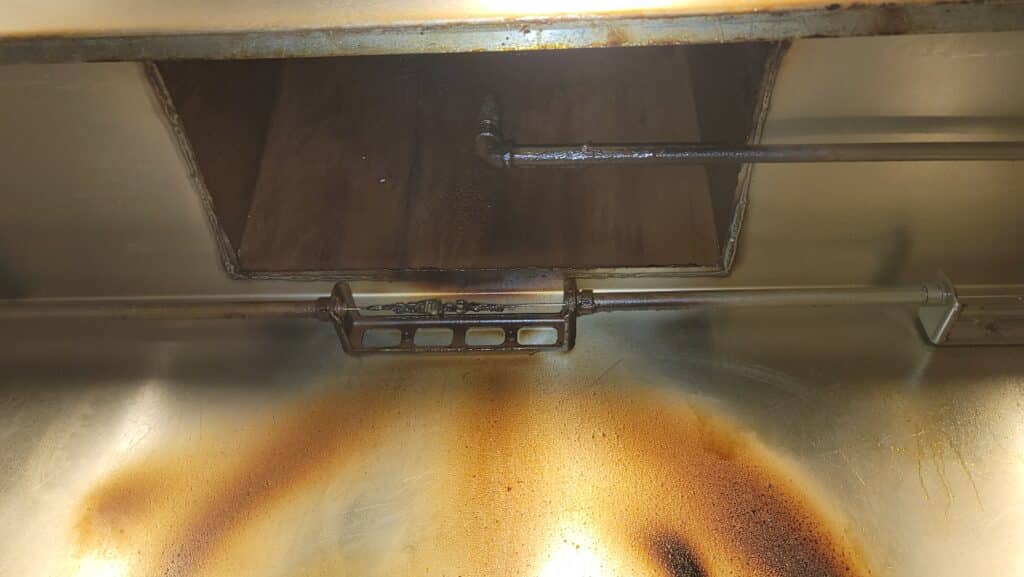
The particles that pass through the filters continue into the duct system, where they begin depositing on the interior duct walls. Grease deposits in the duct system build up over time in layers. Fresh deposits are soft, tacky, and amber-colored. As they age and continue to accumulate, they harden and darken. In high-volume kitchens operating for extended periods without cleaning, the grease deposits inside a duct system can reach depths measured in inches rather than millimeters.
The exhaust fan at the end of the duct run catches grease that makes it all the way through the system. Grease deposits on the fan impeller blades, on the motor housing, and eventually escapes through the discharge point onto the rooftop surface below. At each stage of this journey, the grease is affecting the system it’s passing through.
Effect #1: Fire Risk That Compounds Over Time
The most serious consequence of grease buildup in a commercial kitchen exhaust system is the fire risk it creates. This isn’t a theoretical concern. It’s the reason NFPA 96 exists and the reason Atlanta fire inspectors spend so much time evaluating exhaust system conditions during commercial kitchen inspections.
Grease is combustible. The flash point of many cooking oils and fats is in the range of 300 to 400 degrees Fahrenheit. The autoignition temperature, the point at which the material ignites without an external flame, varies by composition but is generally in the 500 to 700 degree range for common cooking fats. Commercial kitchen cooking surfaces regularly operate at temperatures that approach or exceed these thresholds, particularly on high-output charbroilers, wok burners, and deep fryers.
When grease deposits inside a duct system are exposed to the heat generated during normal cooking operations, they don’t ignite immediately. The accumulation has to reach a sufficient depth and the heat exposure has to be sufficient to raise the deposit temperature to its ignition threshold. But as the deposits grow thicker and the insulating properties of the accumulated grease cause temperatures inside the deposit to rise, the conditions for ignition gradually develop.
A grease fire that starts inside a duct system is a particularly dangerous event. The duct itself becomes a channel that carries the fire upward through the building, generating intense heat and exposing the surrounding building structure to temperatures that can ignite combustible materials on the other side of the duct wall. A duct fire in an Atlanta restaurant that’s run through the ceiling space above the dining room, through an interior wall, or through multiple floors of a mixed-use building creates a fire containment situation that is genuinely difficult to manage.
The Atlanta Fire Rescue Department’s enforcement of NFPA 96 cleaning requirements exists specifically to prevent duct fires from developing. The standard’s cleaning frequency requirements are calibrated to the rate at which grease accumulates in different types of kitchens, with the goal of keeping grease deposits below the threshold at which they create a meaningful ignition risk. When cleaning schedules slip, that threshold is crossed.
Effect #2: Degraded Exhaust System Performance
A commercial kitchen exhaust system is designed to capture cooking vapors at the source and remove them from the kitchen environment efficiently. Grease buildup systematically undermines that function in ways that compound over time.
Filter Restriction
Baffle filters loaded with accumulated grease allow less air to pass through them. As the filter surfaces become coated and the spaces between baffles fill with hardened grease, the open area available for airflow decreases. The result is reduced airflow through the hood, which reduces the system’s ability to capture cooking vapors at the source.
A system that’s running with heavily loaded filters isn’t just marginally less effective. In a high-volume kitchen, the difference between a system with clean filters and one with heavily grease-loaded filters can be dramatic. Smoke that would have been captured immediately above the cooking surface at full airflow is instead hanging in the kitchen environment, depositing on walls, ceilings, and equipment surfaces throughout the space.
Exhaust Fan Degradation
Grease accumulation on exhaust fan impeller blades creates two problems. The first is aerodynamic: grease deposits on the blade surfaces change the blade profile and reduce the fan’s effective output. A heavily grease-coated fan impeller can be moving significantly less air than its rated capacity, compounding the airflow restriction already created by loaded filters.
The second problem is mechanical. Grease deposits on fan impeller blades are rarely uniform. Uneven deposit accumulation creates imbalance in the rotating assembly, which causes vibration. Vibration accelerates wear on the fan motor bearings, on the mounting hardware, and on the structural components that support the fan unit on the rooftop. Left unaddressed, fan imbalance from grease accumulation can shorten the service life of the fan motor significantly.
Reduced Makeup Air Effectiveness
The exhaust system and the makeup air system work together as a matched pair. The exhaust fan removes air from the kitchen; the makeup air system replaces it. When the exhaust fan’s output drops because of grease accumulation, the designed balance between exhaust and makeup air is disrupted. The kitchen may develop positive or negative pressure conditions that affect airflow patterns throughout the space, reduce the hood’s capture efficiency further, and in some cases affect the combustion performance of gas cooking equipment by disrupting the air supply around burners.
Effect #3: Damage to Kitchen Equipment and Surfaces
The grease that doesn’t make it into the exhaust system deposits on every surface it contacts in the kitchen environment. Over time, this creates a layer of grease accumulation on cooking equipment exteriors, walls, ceilings, shelving, and structural elements that creates its own set of problems.
Cooking Equipment Damage
Cooking equipment exteriors that accumulate grease are harder to clean, more prone to harboring bacteria and pests, and in some cases subject to corrosion accelerated by the acidic compounds in oxidized cooking grease. Equipment that’s running in a poorly ventilated kitchen where vapors aren’t being captured efficiently sees heavier exterior accumulation than equipment in a well-maintained, properly ventilated space. Over time, this affects the equipment’s appearance, its compliance with health inspection standards, and in some cases its mechanical performance.
Surface Deterioration
Grease that deposits on kitchen walls and ceilings doesn’t just sit there. It migrates into porous materials, reacts with paints and coatings, and in tile-lined kitchens works its way into grout lines. In kitchens with drywall construction, grease penetration can accelerate deterioration of the wall material itself. The cumulative cost of addressing grease-damaged surfaces during a renovation or after a change of ownership is often substantial.
Rooftop Membrane Damage
Grease that escapes the exhaust discharge point accumulates on the rooftop membrane surrounding the exhaust fan. Commercial roofing membranes are not designed to withstand prolonged grease exposure. Grease saturates the membrane material, breaks down the adhesives and sealants used in the roofing system, and can create areas of membrane failure that allow water intrusion. Atlanta restaurants operating in buildings with flat roofs, particularly older commercial buildings throughout neighborhoods like Inman Park, Cabbagetown, West End, and Midtown, often discover that years of unaddressed rooftop grease accumulation have created roofing repair needs that run into thousands of dollars.
Effect #4: Health Code Compliance Problems
Atlanta restaurant operators are subject to inspection from both the Atlanta Fire Rescue Department and health inspection authorities, and grease buildup that’s gotten out of hand creates problems in both frameworks simultaneously.
Pest Attraction
Accumulated grease is a food source for the insects and rodents that health inspectors are most concerned about in commercial kitchens. Cockroaches, flies, and rodents are all attracted to grease deposits, particularly those that have accumulated in hard-to-reach areas under and behind cooking equipment, inside grease drip troughs, and on the surfaces of kitchen walls and floors. A kitchen with significant grease accumulation is providing an ongoing food source that pest management efforts have to work against continuously.
Bacterial Growth
Old grease deposits are a surface where bacteria can grow, particularly in the temperature ranges found in commercial kitchen environments. The accumulation of biological material in a greasy kitchen creates food safety risks that extend beyond the regulatory consequences. In a kitchen where grease-coated surfaces are present near food preparation areas, the risk of cross-contamination is real and ongoing.
Health Inspection Violations
Health inspectors conducting routine inspections of Atlanta restaurants evaluate the cleanliness of cooking equipment surfaces, exhaust hood surfaces visible from below, wall and ceiling conditions in the kitchen, and the condition of grease collection components. Significant grease accumulation in any of these areas can result in health code violations that overlap with the fire code compliance issues that a fire inspector would cite. A kitchen with serious grease management problems faces scrutiny from multiple regulatory directions simultaneously.
Effect #5: Insurance and Liability Exposure
The relationship between grease buildup and insurance coverage is one that many Atlanta restaurant operators don’t think about until they’re in the middle of a claim. At that point, the documentation they don’t have and the maintenance schedules they didn’t follow become very relevant.
Commercial property insurance policies for restaurants typically include provisions requiring the insured to maintain the property in compliance with applicable fire codes and to perform regular maintenance of fire protection systems. When a grease-related fire occurs in a kitchen with documented maintenance failures, the insurer has grounds to investigate whether the fire was connected to those failures.
An insurer’s post-fire investigation will look at: whether the exhaust system was being cleaned at the NFPA 96-required frequency for the kitchen’s cooking type, whether service documentation was being maintained, whether prior inspections had cited exhaust system violations, and whether the operator had received and addressed any violation notices. A kitchen that was overdue for cleaning, had no service documentation, and had a prior violation on record for the same issue presents a very different claims picture than one that was being maintained properly.
The personal liability exposure for restaurant owners and operators whose kitchens cause fires that spread to neighboring businesses, residential units, or other occupants of a shared building is a related and serious risk. Atlanta’s dense commercial districts mean that a restaurant fire that gets out of the building doesn’t stay in the building. The legal and financial consequences of a fire that damages neighboring properties when the originating kitchen’s exhaust system wasn’t being properly maintained can be severe.
Effect #6: Accelerated Cleaning Costs
There’s a financial dynamic to grease accumulation that works against operators who let maintenance schedules slip. A system that’s been cleaned on schedule has a manageable accumulation level at each service. A system that’s overdue has significantly more grease to remove, which means the cleaning takes longer, requires more chemical product, and in some cases requires multiple service visits to bring the system to a compliant condition.
The cost difference between cleaning a system that’s been maintained on schedule and cleaning one that’s substantially overdue is not proportional. A system with six months of accumulation in a kitchen that should have been cleaned quarterly doesn’t cost twice as much to clean as one that’s on schedule. It often costs considerably more, because hardened, oxidized grease deposits that have been building for months require significantly more effort to remove to bare metal than fresh or moderate accumulation.
Operators who try to save money by extending cleaning intervals or using lower-cost services that don’t perform complete cleanings often end up spending more over time, not less. The cleaning costs go up when the system is eventually serviced properly. The fire inspection violations add re-inspection fees and correction deadlines. The equipment damage that accumulates in a grease-heavy kitchen environment generates repair costs that wouldn’t have occurred in a well-maintained space. And if a fire occurs, the financial impact dwarfs all of these other costs combined.
Effect #7: Operational Disruptions at the Worst Times
Atlanta restaurants don’t operate on a predictable, even schedule. Service volume peaks during events at nearby venues, during restaurant weeks and food festivals, during convention season downtown, and during holidays. The worst time for an operational disruption is always during one of these peaks.
Grease buildup creates operational disruptions through several mechanisms. A fire marshal inspection that discovers significant exhaust system violations can require immediate correction before cooking can resume. A grease fire that starts in a duct system during a busy service doesn’t wait for a convenient time. A rooftop exhaust fan that fails because of bearing wear caused by grease-related imbalance goes down regardless of what’s happening in the kitchen below.
These disruptions share a common characteristic: they’re all predictable from the upstream condition of the exhaust system. A kitchen that’s falling behind on maintenance is accumulating risk that eventually resolves itself in an operational event. The timing of that event is unpredictable, but the event itself is not. Regular professional cleaning eliminates that category of risk rather than just delaying it.
How Atlanta’s Specific Conditions Affect Grease Buildup
Atlanta’s commercial kitchen environment has characteristics that influence how grease buildup develops and how it needs to be managed.
High-Volume Cooking Operations
Atlanta’s food and hospitality sector is substantial. The city’s hotel and convention industry, its university dining operations, its growing food hall and ghost kitchen sector, and its high-profile restaurant scene generate cooking volumes that put serious grease loads on exhaust systems. A restaurant doing 400 covers a night on a menu built around charbroiled proteins is generating grease at a rate that requires monthly professional cleaning. Many Atlanta operators in this category are running quarterly or semi-annual schedules, which means their systems are chronically above the safe accumulation threshold.
The Older Building Stock
A significant portion of Atlanta’s restaurant spaces are located in buildings that were constructed before modern commercial kitchen design standards were established. Converted industrial spaces in the Westside and West Midtown. Repurposed retail buildings in neighborhoods like Ponce City Market’s surroundings and along the Auburn Avenue corridor. Historic buildings throughout the Sweet Auburn district, Little Five Points, and Virginia-Highland. These spaces often have ductwork configurations, ceiling heights, and structural characteristics that were not designed for commercial kitchen exhaust systems. Duct runs that are longer than optimal, ducts that make multiple turns, and duct systems that pass through unusual spaces all tend to accumulate grease faster than purpose-built commercial kitchen installations.
Climate and Humidity
Atlanta’s climate is characterized by warm, humid summers that are long by national standards. Humidity affects grease behavior in exhaust systems in ways that are subtle but real. High ambient humidity can affect the consistency of grease deposits, making some forms of accumulation softer and more mobile than they would be in drier conditions. The interaction of humidity with accumulated grease in exhaust systems creates conditions that are slightly different from what kitchens in drier climates experience, and Atlanta operators running systems without adequate cleaning frequency are managing those conditions whether they realize it or not.
The Difference Between Cleaning and Managing Grease Buildup
There’s an important distinction between cleaning as a reactive response to visible grease problems and managing grease buildup as a proactive operational practice. Most Atlanta restaurant operators are doing the former. The most successful ones are doing the latter.
Reactive cleaning happens when the grease is already visible, when the inspector has already cited the violation, when the fan is already running poorly, when the rooftop has already accumulated a significant grease load. At that point, the cleaning is remediation. It addresses the accumulated problem but doesn’t prevent the next accumulation cycle from reaching the same critical point.
Proactive grease management means scheduling professional cleaning at the NFPA 96-required frequency for the actual cooking type and volume, maintaining proper documentation, having filters checked and cleaned on a regular basis between professional services, monitoring the signs of accumulation covered in the previous article in this series, and working with a cleaning company that communicates what it observes during each service. This approach keeps the system consistently below the accumulation thresholds that create fire risk, compliance violations, and operational disruptions.
The financial and operational difference between these two approaches is significant. Reactive cleaning addresses problems that have already developed. Proactive management prevents those problems from developing. The cost of prevention is consistently lower than the cost of remediation.
What a Professional Cleaning Actually Removes
When a professional hood cleaning company performs NFPA 96-compliant service on an Atlanta commercial kitchen exhaust system, the physical scope of what’s removed is worth understanding. It’s not a surface wipe-down. It’s a systematic removal of combustible grease deposits from every component in the exhaust pathway.
From the hood canopy and plenum, the technicians remove the accumulated grease coating from the interior metal surfaces, restoring them to a bare-metal condition. From the baffle filters, they remove the grease deposits that have built up in the filter channels, or replace the filters if they’ve degraded beyond effective cleaning. From the grease drip troughs and collection cups, they remove the accumulated liquid and semi-solid grease that has been draining from the filters.
From the duct interior, accessible through the system’s access panels, they remove grease deposits from the duct walls throughout the entire duct run. In systems that are substantially overdue, this can mean removing layers of hardened, darkened grease that have built up over months or years. From the exhaust fan, they clean the impeller blades, the motor housing, and the fan base, removing the grease accumulation that has been degrading the fan’s performance and creating mechanical stress on the motor. From the rooftop area, they remove grease accumulation from the rooftop surface around the fan discharge.
The service documentation that follows this cleaning, including before-and-after photographs, makes the scope of what was removed visible in a way that no description can fully convey. The photographic record of a substantially overdue exhaust system before cleaning compared to the same system after compliant professional service is dramatic. The fire risk that was present before the cleaning and is gone after it is equally dramatic, even if it’s not visible in the same way.
Frequently Asked Questions About Grease Buildup in Atlanta Kitchens
Does grease buildup in the hood affect my health inspection scores as well as my fire inspection?
Yes. Health inspectors in Atlanta evaluate kitchen cleanliness including the visible surfaces of the hood and cooking equipment. Significant grease accumulation on the hood’s visible exterior surfaces, on the filter faces, or on the cooking equipment below can result in health code violations. The fire code violation risk exists in the hood interior and duct system, while the health inspection risk tends to be more visible-surface oriented. Both are affected by inadequate exhaust system maintenance.
My fryer is old and seems to produce a lot of grease vapor. Should I be cleaning the hood more often than the NFPA 96 schedule suggests?
Cooking equipment that’s functioning below design efficiency often produces more smoke and vapor than equipment in good condition. An older fryer with a degraded heating element, a thermostat that’s running hot, or a burner that’s partially blocked may be generating more grease vapor than a properly functioning fryer of the same type. If you’ve noticed increased smoke or vapor production from older equipment, both evaluating the equipment’s condition and assessing whether your cleaning frequency needs to be adjusted are reasonable steps.
I have multiple hoods in my kitchen. Does grease accumulate at the same rate in all of them?
No. The rate of grease accumulation in each hood is a function of what’s cooking beneath it. A hood over a charbroiler accumulates grease significantly faster than a hood over a convection oven baking the same quantity of food. If your kitchen has hoods over different equipment types, the cleaning frequency for each should reflect the cooking volume and type under that specific hood. A professional hood cleaning company that assesses your full kitchen layout will factor this into their service plan.
Is there anything I can do between professional cleanings to slow grease accumulation?
Yes. Daily or weekly cleaning of baffle filters, depending on cooking volume, removes the accumulated surface grease before it hardens and becomes more difficult to remove. Cleaning the visible surfaces of the hood canopy interior on a regular basis also helps. These in-house maintenance practices don’t replace professional cleaning and don’t satisfy the NFPA 96 requirement for professional service, but they reduce the accumulation rate in the components you can reach, which keeps the system functioning more efficiently between service visits.
How long does it take for grease to reach a dangerous accumulation level in a high-volume kitchen?
In a high-volume kitchen using charbroilers, wok burners, or solid-fuel cooking equipment, grease accumulation in the exhaust system can reach concerning levels within a matter of weeks during full operation. This is why NFPA 96 requires monthly cleaning for these operations. A kitchen of this type that’s operating on a quarterly cleaning schedule is spending two months out of every three above the accumulation threshold that the code considers safe. The fire risk is present throughout those two months, not just at the point when the cleaning is finally performed.
Does weather affect how quickly grease accumulates in the exhaust system?
Ambient temperature and humidity have some effect on grease deposit consistency and migration behavior, but the primary driver of accumulation rate is cooking activity. A kitchen running the same cooking volume in an Atlanta summer and an Atlanta winter will see broadly similar accumulation rates. Seasonal variation in menu offerings or operating hours that affects cooking volume will have a more meaningful effect on accumulation rate than weather conditions directly.
Grease Buildup Is Predictable. So Is the Solution.
Grease accumulation in Atlanta commercial kitchens is a certainty. Every kitchen that cooks is producing grease vapor. Every exhaust system that runs is accumulating deposits. The only variable is whether those deposits are being removed at a frequency that keeps them below the thresholds that matter for fire safety and code compliance.
The effects covered in this article, including the fire risk, the equipment damage, the health code exposure, the insurance implications, and the operational disruptions, are all downstream consequences of a single upstream condition: grease that’s been allowed to accumulate beyond what the system can safely hold.
Professional hood cleaning at the correct NFPA 96-required frequency for your cooking operation is the mechanism that prevents those downstream consequences from developing. It’s not complicated. It’s not particularly expensive relative to the risks it addresses. And it’s the single most effective maintenance action an Atlanta restaurant operator can take to protect the physical safety of the kitchen, the regulatory compliance of the business, and the continuity of operations.
Premier Grease has been helping Atlanta commercial kitchens manage grease buildup since 2001. We clean exhaust systems from filters to rooftop fan to NFPA 96’s bare-metal standard, and we provide full documentation including time-stamped before-and-after photographs with every service. No contracts. Licensed, bonded, and insured with $5 million in general liability coverage. We schedule around your hours so the cleaning happens when your service is finished.
Call us 24/7 at 1-800-880-1142 or visit Hood Cleaning Atlanta to schedule a free estimate and get your kitchen’s grease management on a schedule that works.